 Mon - Fri: 9:00 - 19:00 GTM

Oakmoss Resinoid: What It Is, How It Is Produced and Used in Perfumery
Oakmoss resinoid is a concentrated aromatic material associated with the extraction of
Evernia prunastri, the lichen traditionally known as true oakmoss in perfumery. It belongs to a very different stage of the fragrance supply chain from the dried lichen used as extraction feedstock.
What Is Oakmoss Resinoid?
In natural fragrance processing, a resinoid is a concentrated extract typically obtained from a dry botanical raw material through solvent extraction. In the case of oakmoss, the starting botanical traditionally associated with the material is Evernia prunastri.
Extraction transfers a complex mixture of soluble constituents from the dried lichen into the extraction medium. After separation of the spent botanical material and removal of the solvent under controlled processing conditions, a concentrated aromatic material remains.
The resulting resinoid is therefore not simply powdered or concentrated dried lichen. It is a processed fragrance ingredient whose composition, odor and physical properties depend on both the original botanical feedstock and the extraction process.
Essential distinction:
raw oakmoss is botanical extraction feedstock. Oakmoss resinoid is a manufactured fragrance ingredient obtained after extraction and concentration.
From Raw Oakmoss Lichen to Resinoid
Understanding where resinoid sits in the supply chain prevents a common sourcing mistake: treating the natural lichen and the finished fragrance ingredient as interchangeable commercial products.
Raw Lichen
Botanical material collected and prepared as industrial feedstock.
Preparation
Cleaning, inspection and preparation according to the extractor’s specification.
Extraction
Soluble aromatic constituents are recovered from the botanical matrix.
Concentration
The extraction medium is removed and the aromatic fraction concentrated.
Resinoid
Concentrated aromatic ingredient ready for further evaluation, processing or fragrance use.
What Does Oakmoss Resinoid Look Like?
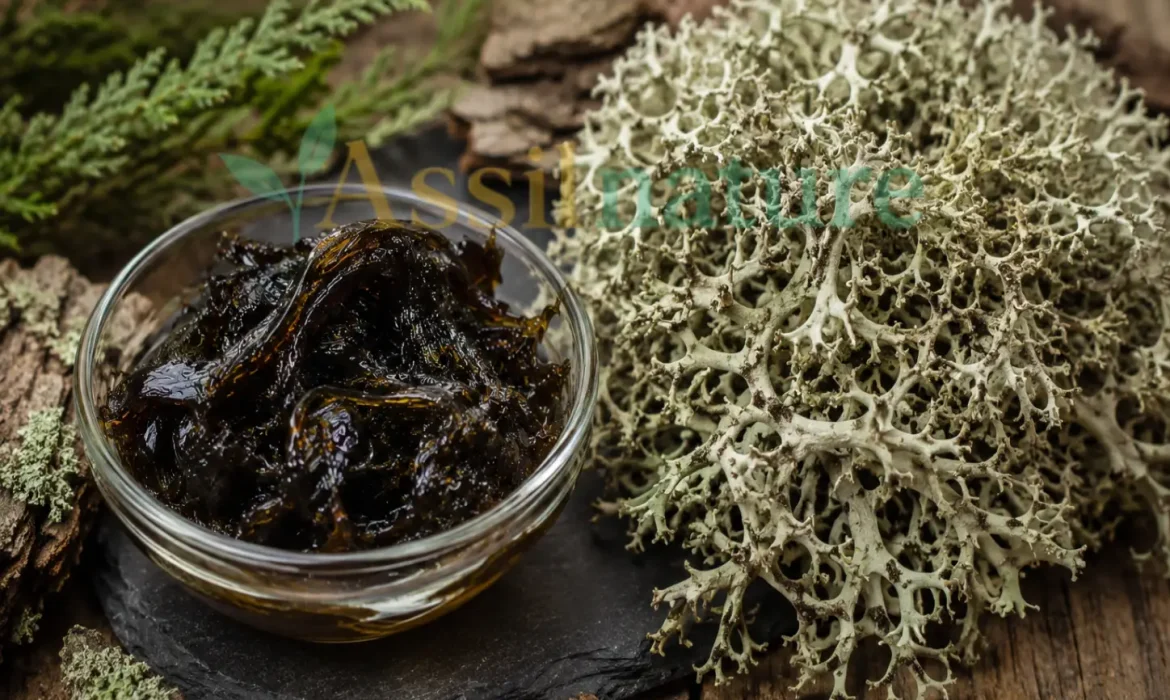
Unlike the branching structure of dried lichen, a resinoid is generally a dense, highly concentrated material. Its physical appearance can vary with manufacturing method, degree of purification, temperature and commercial grade.
It may range from a viscous or semi-solid extract to a more solid resinous mass. Color can also vary, commonly appearing in darker green, brown-green or brownish tones depending on processing and specification.
Appearance alone, however, is not sufficient to establish quality. Industrial evaluation depends on the manufacturer’s sensory, analytical and regulatory specification for the particular commercial grade.
What Does Oakmoss Resinoid Smell Like?
Traditional oakmoss materials are valued for an unusually complex natural odor profile. A resinoid can present combinations of mossy, earthy, woody, forest-like, leathery and humid tonalities, together with darker nuances that contribute depth to a fragrance base.
The precise profile is not universal. Botanical variation, extraction conditions and subsequent treatment can change both the intensity and balance of individual facets.
Mossy & Forest-Like
The characteristic natural identity traditionally associated with oakmoss.
Earthy
Deep soil and woodland-floor impressions that reinforce natural depth.
Woody & Leathery
Darker base-note facets that can add structure and complexity.
Why Has Oakmoss Resinoid Been Important in Perfumery?
Oakmoss became historically significant because its extracts could provide a type of depth and natural complexity that was difficult to reduce to a single odor molecule.
It became particularly associated with classical chypre and fougère structures, where mossy materials helped build the darker, earthy and forest-like foundation of the composition.
Modern formulation practices and safety requirements have changed how natural oakmoss materials are processed and used, but their historical and technical importance remains central to understanding natural fragrance ingredients.
Oakmoss resinoid is only one form encountered in the fragrance industry. The next distinction is particularly important for buyers and formulators: how does an oakmoss resinoid differ from an oakmoss absolute, and why should the two terms not be used interchangeably?
Oakmoss Resinoid vs Oakmoss Absolute: What Is the Difference?
The terms oakmoss resinoid and oakmoss absolute are both used for processed fragrance ingredients, but they should not be assumed to describe the same material.
A resinoid is generally associated with the primary concentrated extract obtained from a dry aromatic raw material. An absolute usually refers to a further processed or selectively refined aromatic fraction derived from an earlier extract.
The exact manufacturing route and commercial terminology can vary between producers, which is why the technical specification supplied by the manufacturer is more reliable than the product name alone.
Oakmoss Resinoid
Typically a dense aromatic extract obtained from dried oakmoss through solvent-based extraction and concentration.
Oakmoss Absolute
A more selectively processed aromatic fraction whose composition and sensory profile depend on the producer’s refining process.
Buyer note: resinoid, absolute and extract are commercial fragrance-material terms. Their precise composition should always be verified through the supplier’s specification, analytical documentation and intended-use information.
For the broader ingredient category and its relationship with the botanical feedstock, see our guide to Evernia prunastri extract .
Why Processing Changes the Final Oakmoss Ingredient
Once the aromatic constituents have been extracted from the lichen, further processing can alter the composition, odor profile, physical properties and regulatory characteristics of the finished ingredient.
Several production variables can therefore distinguish one commercial oakmoss material from another.
How Is Oakmoss Resinoid Quality Evaluated?
Quality evaluation of a resinoid is different from evaluating the dried lichen used to produce it. The finished extract is judged as a fragrance ingredient and therefore requires a combination of sensory, physical, analytical and regulatory assessment.
Depending on the manufacturer’s specification and target market, evaluation may include:
Does Raw Oakmoss Quality Affect Resinoid Production?
Yes. The quality of the dried lichen determines the botanical matrix entering the extraction process. Although manufacturing has a major influence on the finished resinoid, processing cannot make raw-material identity and consistency irrelevant.
Excessive foreign matter, unstable moisture, mixed botanical material or inconsistent lot preparation can affect extraction efficiency and complicate standardisation.
For recurring industrial production, raw-material qualification therefore becomes part of finished-ingredient quality management.
Industrial principle: a consistent resinoid begins with a controlled extraction process, but also with correctly identified and suitably prepared botanical feedstock.
Why Batch Consistency Matters in Oakmoss Resinoid
Natural extracts inevitably reflect some variability in the biological material from which they are produced. For fragrance manufacturers, however, uncontrolled variation can create difficulties when an ingredient is used repeatedly in established formulas.
Extract producers therefore rely on raw-material qualification, process control, analytical assessment and, where appropriate, standardisation to maintain commercially acceptable consistency.
This is especially important for customers purchasing a fragrance ingredient under the same commercial specification over multiple production batches.
Quality is only one side of the modern oakmoss-resinoid market. Its use is also shaped by fragrance-safety requirements, atranol and chloroatranol controls, treated commercial grades and the way contemporary perfumers work with mossy ingredients.
How Modern Oakmoss Resinoids Differ from Historical Materials
The oakmoss materials used by the fragrance industry today should not automatically be assumed to have the same composition as historical extracts. Advances in analytical chemistry, fragrance-safety assessment and processing technology have changed the way commercial oakmoss ingredients are manufactured and specified.
Modern producers can apply additional purification, selective processing and quality-control steps to manage constituents that are important from a safety or regulatory perspective.
As a result, the term oakmoss resinoid describes a product category rather than one universally identical chemical composition. The specification of the individual commercial grade remains essential.
Why Are Atranol and Chloroatranol Important in Oakmoss?
Atranol and chloroatranol became particularly important in the modern history of oakmoss because of their association with skin sensitisation. Their presence in traditional oakmoss-derived fragrance materials contributed to significant changes in how these ingredients are processed and controlled.
This led the fragrance industry to develop more highly processed commercial materials in which relevant constituents can be reduced and analytically controlled.
For a fragrance manufacturer, the relevant information therefore comes from the actual analytical and regulatory documentation of the finished ingredient, rather than from the words “oakmoss” or “resinoid” alone.
Important distinction: the presence of naturally occurring precursors or related constituents in raw lichen and the regulatory specification of a processed fragrance ingredient are different technical questions. The finished extract must be assessed according to its own composition and intended use.
What Does “Low-Atranol Oakmoss” Mean?
The fragrance market includes specially processed oakmoss materials designed to reduce constituents of regulatory concern. These are sometimes described commercially using terms such as low-atranol, treated or purified oakmoss.
Such terminology should not be interpreted as a universal technical specification. Different manufacturers may use different processing technologies and product specifications.
Professional buyers should therefore request the relevant technical documentation and analytical data for the specific commercial material under evaluation.
Is Oakmoss Resinoid Banned in Perfumery?
Saying that oakmoss is simply “banned” does not accurately describe the modern fragrance landscape. Oakmoss-derived fragrance materials are subject to important safety restrictions and compositional requirements, and their use depends on the specific ingredient, its composition and the intended application.
IFRA Standards form an important part of fragrance-industry safe-use practice, while legal requirements can also apply according to jurisdiction and finished-product category.
Formulators and ingredient buyers should therefore work from current documentation for the specific commercial grade rather than relying on general statements about historical oakmoss use.
For a dedicated review of the applicable safety framework, see our guide to Oakmoss IFRA restrictions , including atranol, chloroatranol and modern fragrance-safety considerations.
How Is Oakmoss Used in Modern Perfumery?
The regulatory evolution of oakmoss has changed its use, but it has not erased the importance of the mossy olfactory family. Contemporary perfumers can work with compliant natural oakmoss-derived materials alongside other natural and synthetic ingredients to construct the desired mossy effect.
In modern formulations, the objective may be to preserve aspects of the traditional oakmoss character while achieving greater control over composition, consistency and safe-use requirements.
This makes oakmoss an interesting example of how a historically important natural material can evolve through analytical science and extraction technology while remaining relevant to contemporary fragrance creation.
Raw Lichen and Oakmoss Resinoid Are Two Different B2B Markets
For procurement purposes, it is useful to separate the upstream botanical market from the downstream fragrance-ingredient market.
| Factor | Raw Lichen | Oakmoss Resinoid |
|---|---|---|
| Product stage | Botanical feedstock | Processed fragrance ingredient |
| Primary buyer | Extractor / fragrance-ingredient manufacturer | Fragrance house / compounder / formulator |
| Core specification | Species, origin, moisture, cleanliness, foreign matter | Sensory, chemical, physical and regulatory parameters |
| Value creation | Sourcing and preparation | Extraction, refining and standardisation |
Commercial implication: a supplier of dried fragrance lichen should not be presented as a manufacturer of oakmoss resinoid unless extraction is actually performed and the resulting fragrance ingredient is supplied under its own technical specification.
The finished resinoid ultimately begins with a natural botanical feedstock. For extraction companies, this brings the discussion back upstream: which lichen is being purchased, how botanical identity is controlled, and what makes a bulk raw-material lot suitable for industrial resinoid production.
What Raw Material Is Used to Produce Oakmoss Resinoid?
In the traditional perfumery definition, true oakmoss raw material is associated with the lichen Evernia prunastri. When a manufacturer intends to produce an ingredient specifically identified as oakmoss resinoid, botanical identity therefore becomes a fundamental part of raw-material qualification.
Commercial names alone are not sufficient. The international lichen trade has historically used overlapping terminology, while different aromatic lichen species can enter related fragrance applications.
For industrial procurement, the safest approach is to specify the required botanical species, physical characteristics, origin and acceptance criteria before comparing commercial offers.
Evernia prunastri vs Pseudevernia furfuracea for Resinoid Production
Evernia prunastri and Pseudevernia furfuracea are both established fragrance lichens, but they represent different botanical raw materials and should not be merged into a single industrial specification.
Evernia prunastri is traditionally associated with oakmoss. Pseudevernia furfuracea is principally associated with treemoss and has also been described as cedarmoss in specific historical and trade contexts, particularly when associated with cedar hosts.
Because their chemical profiles and resulting extracts can differ, a manufacturer should qualify the species according to the fragrance ingredient it intends to produce rather than treating one lichen as an automatic substitute for the other.
Industrial rule: if the target product is specifically an oakmoss resinoid, the botanical identity required by the manufacturer’s specification should be established before purchasing the extraction feedstock.
What Should a Resinoid Manufacturer Specify When Buying Raw Lichen?
A useful RFQ for extraction-grade lichen should go beyond the product name and quantity. Defining the critical parameters before quotation allows suppliers to determine whether they can prepare material that genuinely fits the process.
| Parameter | Why It Matters |
|---|---|
| Botanical species | Establishes the identity of the extraction feedstock. |
| Origin & traceability | Supports lot control, supplier qualification and sourcing documentation. |
| Moisture | Influences dry-matter value, storage stability and processing. |
| Foreign matter | Bark, wood, soil and unrelated material reduce the proportion of useful feedstock. |
| Physical preparation | Cleaning, sorting and particle condition may influence processing efficiency. |
| Required testing | Buyer-specific analyses should be agreed before commercial preparation. |
| Annual volume | Determines whether the required specification can realistically be maintained at production scale. |
Why Pilot Extraction Can Be More Valuable Than Visual Inspection
Visual inspection can reveal cleanliness, color, physical condition and obvious foreign matter, but it cannot by itself predict how a raw lichen will perform in a manufacturer’s extraction system.
A representative sample allows the buyer to perform botanical verification and analytical evaluation and, where appropriate, a laboratory or pilot-scale extraction using its own process.
This can provide practical information about extract yield, physical behaviour and sensory characteristics before the manufacturer commits to a larger commercial lot.
Raw Lichen Price vs Extraction Value
For a resinoid producer, the cheapest raw lichen per kilogram is not necessarily the lowest-cost feedstock.
A shipment containing excessive moisture or non-lichen material may offer less usable dry botanical matter per purchased kilogram. Inconsistent material may also increase sorting, qualification and process-control costs.
Industrial purchasing decisions are therefore stronger when price is evaluated together with usable material, extraction performance, specification conformity and supply consistency.
Procurement perspective: the economically relevant question is not only “What is the price per kilogram?” but “What is the cost of the qualified raw material required to produce a consistent finished extract?”
Before Purchasing Lichen for Resinoid Production
Oakmoss Resinoid Connects Perfumery with Botanical Sourcing
Oakmoss resinoid occupies an important position between natural botanical sourcing and finished fragrance formulation. It transforms dried aromatic lichen into a concentrated ingredient with a complex mossy character and a long history in perfumery.
Yet the word “resinoid” alone does not define the quality of a commercial product. Botanical feedstock, extraction technology, refining, analytical control and regulatory requirements all influence the resulting ingredient.
For extract manufacturers, this makes upstream qualification essential. Correct species, clean and appropriately dried material, traceability and lot consistency create a stronger foundation for reproducible industrial extraction.
For the wider relationship between Oakmoss, Moroccan Cedarmoss, botanical identity, extraction, quality and industrial sourcing, explore our complete guide to Moroccan Cedarmoss and Oakmoss .
For fragrance buyers, the downstream principle is equally important: evaluate the actual resinoid specification and analytical documentation rather than relying solely on historical or commercial terminology.
In short: oakmoss resinoid is the result of an industrial extraction process, but the quality chain begins earlier—with the identity, preparation and consistency of the natural lichen entering that process.
Frequently Asked Questions
What is oakmoss resinoid?
Oakmoss resinoid is a concentrated aromatic material produced from oakmoss lichen through extraction and concentration. In traditional perfumery terminology, true oakmoss is associated with Evernia prunastri. The resinoid is a processed fragrance ingredient and should be distinguished from the dried lichen used as extraction feedstock.
How is oakmoss resinoid produced?
Oakmoss resinoid is generally produced by extracting prepared dried lichen with an appropriate extraction medium, separating the botanical material and concentrating the recovered aromatic fraction. The exact industrial process, solvent system and subsequent treatment can vary between manufacturers.
What is the difference between oakmoss resinoid and oakmoss absolute?
A resinoid generally refers to a concentrated primary extract obtained from a dry aromatic raw material, while an absolute usually involves further processing or selective refinement of an earlier extract. Commercial terminology can vary, so buyers should verify the technical specification of the actual ingredient.
Is oakmoss resinoid the same as Evernia prunastri extract?
Oakmoss resinoid can fall within the broader category of Evernia prunastri extracts, but the terms should not automatically be treated as exact synonyms. “Extract” is a broad description, whereas “resinoid” usually refers to a particular type or stage of concentrated aromatic extract.
What does oakmoss resinoid smell like?
Traditional oakmoss resinoids can display complex mossy, earthy, woody, forest-like and leathery facets. The precise odor profile depends on the botanical feedstock, extraction process, refining and the specification of the commercial grade.
What is oakmoss resinoid used for in perfumery?
Oakmoss materials have historically been important in fragrance bases, particularly in classical chypre and fougère structures. They contribute mossy, earthy and woody depth. Modern use depends on the composition and safe-use requirements of the specific commercial ingredient.
Is oakmoss resinoid made from Evernia prunastri?
In traditional botanical and perfumery terminology, true oakmoss is Evernia prunastri. When an ingredient is specifically represented as an oakmoss resinoid, botanical identity of the original feedstock is therefore an important part of technical qualification.
Is Pseudevernia furfuracea the same raw material as oakmoss?
No. Pseudevernia furfuracea and Evernia prunastri are different lichen species. P. furfuracea is principally associated with treemoss and, in specific cedar-host trade contexts, cedarmoss. The two materials should not be substituted automatically in an extraction specification.
What is low-atranol oakmoss?
Low-atranol oakmoss generally refers to specially processed commercial oakmoss material designed to reduce constituents of safety concern. The expression is not a universal specification, so buyers should review analytical and technical documentation for the particular ingredient offered.
Is oakmoss resinoid banned?
It is misleading to describe oakmoss resinoid simply as banned. Oakmoss-derived fragrance materials are subject to important compositional and safe-use requirements. The acceptability and permitted use of a particular ingredient depend on its composition, intended application and the applicable regulatory and fragrance-safety framework.
Does IFRA regulate the use of oakmoss materials?
IFRA Standards are an important part of the fragrance industry's safe-use framework for oakmoss-derived ingredients. Formulators should consult the current applicable IFRA documentation together with any legal requirements relevant to the destination market and finished product.
What affects the quality of oakmoss resinoid?
Quality can be influenced by botanical identity and condition of the raw lichen, extraction technology, refining, standardisation and batch control. Finished resinoids may also be evaluated for sensory profile, physical characteristics, chemical composition and regulatory conformity.
What should an extractor check before buying raw lichen for resinoid production?
Important parameters include botanical species, origin, traceability, moisture, cleanliness, foreign matter, physical preparation, required analyses, representative sample approval and the supplier's ability to maintain the agreed specification across commercial volumes.
References
The botanical, extraction and fragrance-industry distinctions discussed in this article are supported by established scientific literature and professional fragrance-safety documentation.
Joulain, D. & Tabacchi, R. (2009).
Lichen extracts as raw materials in perfumery. Part 1: Oakmoss.
Flavour and Fragrance Journal, 24, 49–61.
DOI: 10.1002/ffj.1916
Joulain, D. & Tabacchi, R. (2009).
Lichen extracts as raw materials in perfumery. Part 2: Treemoss.
Flavour and Fragrance Journal, 24, 105–116.
DOI: 10.1002/ffj.1923
British Lichen Society.
Evernia prunastri species account.
Botanical characteristics and identification information for true oakmoss.
British Lichen Society – Evernia prunastri
British Lichen Society.
Pseudevernia furfuracea species account.
Botanical reference supporting the distinction between treemoss-type material and Evernia prunastri.
British Lichen Society – Pseudevernia furfuracea
International Fragrance Association (IFRA).
IFRA Standards Documentation.
Professional reference for fragrance-material safe-use standards and related technical documentation.
IFRA Standards Documentation
Technical note:
fragrance-liken terminology has historically varied across scientific and commercial sources. For procurement and industrial extraction, botanical identity and the technical specification of the actual commercial material should take precedence over trade names alone.
Looking for Raw Lichen for Fragrance Extraction?
Assil Nature supplies Moroccan fragrance lichen in the Pseudevernia furfuracea sourcing context for professional B2B and industrial requirements. Buyers can discuss sample evaluation, raw-material specifications, bulk quantities and export supply.
How Sun Exposure Affects Essential Oil Concentration (Industrial Guide)
In industrial botanical sourcing, essential oil concentration is not a “nice-to-know” it’s a measurable factor that can affect extraction yield, aroma intensity, chemotype stability, and batch consistency. One of the strongest drivers behind those differences is sun exposure.
At Assil Nature, we work within a Mediterranean environment where sunlight intensity and seasonal patterns can shape the chemistry of aromatic plants.
This guide explains how and why sunlight changes essential oil concentration, and what that means for manufacturers buying Moroccan medicinal herbs in bulk.
If you’re building a sourcing strategy around Moroccan botanicals, start with our guide: Moroccan Medicinal Herbs Guide
.
Why this matters for B2B buyers
- Extraction yield: concentrated oils can reduce the raw material volume needed per kg of extract.
- Terpene profile stability: sunlight influences key compounds (e.g., thymol, carvacrol, cineole, linalool).
- Quality control: UV + heat + water stress can change aroma and oxidation sensitivity.
- Supplier consistency: understanding sun exposure helps interpret seasonal variation in COA results.
The science of essential oil formation
Essential oils are secondary metabolites. Plants do not produce them for basic nutrition; they produce them to adapt to their environment.
In aromatic crops, these volatile compounds can help with UV protection, pest resistance, and microbial defense.
Sun exposure can influence essential oils through three main mechanisms:
- Photosynthetic energy: sunlight increases photosynthesis, providing more energy for metabolite synthesis.
- Stress signaling: UV and heat trigger defensive pathways that can increase certain terpenes.
- Gland development: strong sun conditions can affect the density and activity of oil glands (trichomes).
The key is balance: moderate stress can increase concentration, but excessive heat/UV can degrade delicate volatiles and reduce overall biomass.
That’s why professional sourcing focuses on both yield and profile.
Sunlight intensity: Moderate vs. Strong Sun Exposure
The intensity, duration, and seasonal pattern of sun exposure create measurable differences in oil yield and terpene profile.
Moderate Sun Exposure
In regions with balanced sunlight and mild temperatures, aromatic plants often produce:
- Stable biomass growth
- Balanced terpene composition
- Lower phenolic intensity
- More subtle aromatic profile
These conditions are typically found in temperate or northern European climates where UV intensity is lower and drought stress is minimal.
Strong Mediterranean Sun Exposure
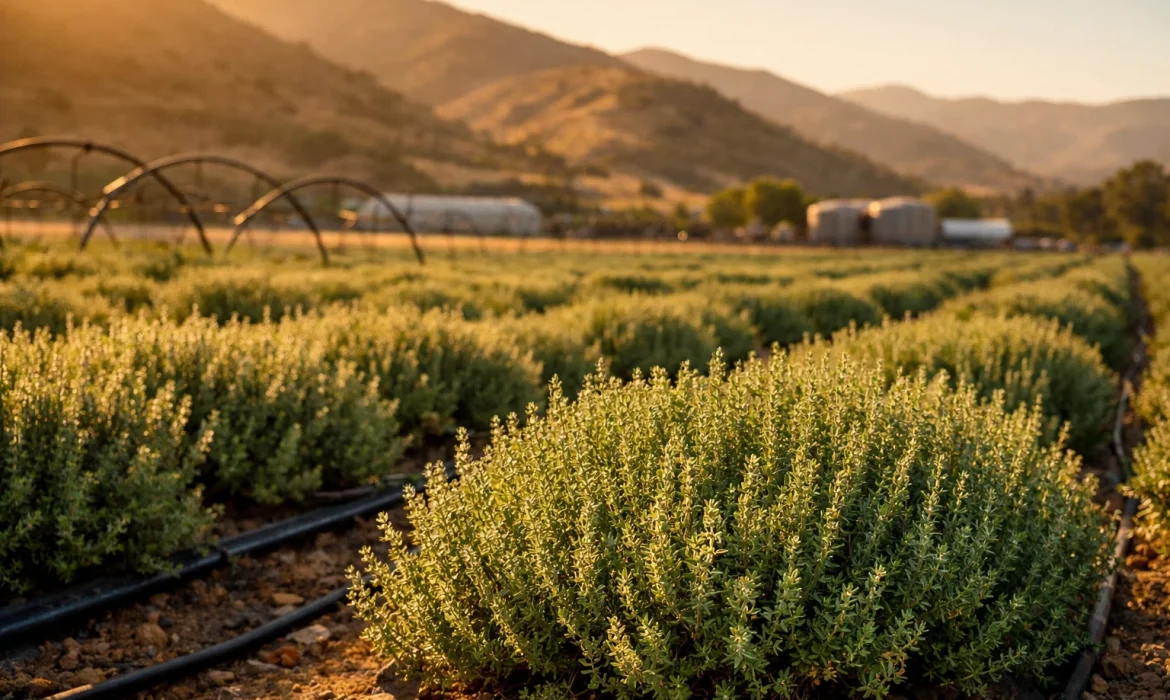
In Mediterranean climates like Morocco, long daylight hours and high UV levels create a different biochemical response.
Plants adapt by increasing protective compounds, many of which are components of essential oils.
- Higher glandular trichome density
- Increased phenolic compounds (e.g., thymol, carvacrol)
- More intense aromatic profile
- Higher oil concentration per dry weight (in many species)
This is one reason why Moroccan thyme, rosemary, and oregano are often valued in international markets.
You can explore more about regional plant advantages in our
Moroccan Medicinal Herbs Guide
.
UV Radiation and Essential Oil Chemical Composition (Chemotypes)
Sun exposure does not only influence the quantity of essential oil.
It can also affect the chemical composition — particularly the balance of dominant compounds.
In aromatic crops, UV radiation stimulates stress-response pathways that alter terpene biosynthesis.
Examples of Sun-Influenced Compounds
- Thyme: Thymol concentration may increase under higher UV stress.
- Oregano: Carvacrol levels can shift depending on sunlight intensity.
- Rosemary: 1,8-Cineole and camphor ratios may vary by exposure.
- Lavender: Linalool and linalyl acetate balance may fluctuate seasonally.
These variations create what are known as chemotypes — plants of the same species but with different dominant chemical compounds.
For B2B buyers, this means origin and sun exposure conditions are not cosmetic details.
They directly influence:
- Antimicrobial activity
- Flavor intensity
- Therapeutic applications
- Extraction efficiency
Professional sourcing requires understanding seasonal sun patterns and how they translate into COA variability.
Sun Exposure, Water Stress, and Essential Oil Concentration
Sun exposure rarely acts alone. In Mediterranean environments, strong sunlight is often accompanied by controlled water stress.
The interaction between solar radiation and irrigation management plays a decisive role in essential oil concentration.
Moderate Water Stress Effect
When aromatic plants experience moderate drought conditions combined with high sun exposure, they activate stress-defense mechanisms.
This frequently leads to:
- Increased terpene synthesis
- Higher oil concentration per gram of dry matter
- Stronger phenolic compound expression
However, excessive stress may reduce biomass yield and overall harvest volume.
The goal in professional cultivation is controlled stress — not uncontrolled dehydration.
At industrial level, experienced producers carefully balance:
- Drip irrigation cycles
- Soil mineral management
- Seasonal sun exposure intensity
- Pre-harvest moisture levels
Daily Fluctuation: When Does Essential Oil Concentration Peak?
Essential oil concentration is not constant throughout the day.
Sunlight triggers metabolic activity that can fluctuate between morning and midday.
Morning Harvest
- Lower evaporation losses
- Better volatile preservation
- Reduced oxidative degradation
Midday Harvest
- Peak photosynthetic activity
- Maximum metabolic production in certain species
- Higher oil concentration in some aromatic crops
Professional farms often conduct small-batch lab testing to determine the optimal harvesting window for each species.
This ensures maximum oil yield while maintaining chemical stability.
Seasonal Sun Exposure and Annual Oil Variation
Beyond daily fluctuations, seasonal sun exposure significantly impacts essential oil concentration.
Summer months in high-sun regions often produce:
- More concentrated aromatic compounds
- Higher phenolic percentages
- Stronger antimicrobial properties
Spring harvests may offer:
- More delicate aromatic balance
- Lower phenolic harshness
- Preferred profile for cosmetic formulations
For B2B buyers, this highlights the importance of:
- Seasonal sourcing transparency
- COA comparison across harvest cycles
- Understanding regional climate patterns
Post-Harvest Handling: Preserving Sun-Induced Essential Oil Concentration
Sun exposure may increase essential oil concentration in the field, but poor post-harvest handling can quickly destroy that advantage.
After harvest, aromatic plants remain chemically active. Improper drying, excessive heat, or prolonged UV exposure may cause:
- Oxidation of volatile compounds
- Loss of top-note aromatics
- Reduction in terpene stability
- Color degradation
Controlled Drying vs. Open Sun Drying
Open sun drying may seem traditional, but extended UV exposure can degrade delicate essential oil fractions.
Controlled drying environments allow:
- Temperature regulation
- Airflow optimization
- Moisture balance control
- Protection from excessive UV degradation
This ensures that the natural advantage gained from Mediterranean sun exposure is preserved rather than compromised.
Sun Exposure and Industrial Extraction Efficiency
For manufacturers, essential oil concentration directly affects extraction economics.
Higher concentration plants may result in:
- Improved steam distillation yield
- Reduced raw material consumption
- More efficient CO2 extraction
- Stronger aromatic intensity in finished products
However, extremely high phenolic content may require careful handling depending on the intended application (cosmetic vs. pharmaceutical vs. flavoring).
This is why origin, climate data, and harvest documentation should be part of any professional sourcing agreement.
Mediterranean vs. Cooler Climate: A Comparative Overview
| Factor | Mediterranean Climate | Cooler / Northern Climate |
|---|---|---|
| Annual Sun Hours | High | Moderate |
| UV Intensity | Strong | Lower |
| Oil Concentration (per dry weight) | Often Higher | Moderate |
| Phenolic Compounds | Elevated in some species | Balanced |
| Biomass Yield | Slightly Lower | Often Higher |
Both climates have advantages.
Mediterranean regions may produce more concentrated oils,
while cooler climates may offer larger biomass yield.
The optimal sourcing strategy depends on your formulation goals,
regulatory requirements, and target chemical profile.
Strategic Buyer Checklist: Evaluating Sun Exposure Impact Before Purchasing
For industrial buyers sourcing aromatic plants or essential oil raw material, understanding sun exposure conditions can improve purchasing decisions and long-term consistency.
Before finalizing a supplier, consider asking:
- What is the average annual sun exposure in the cultivation region?
- Is irrigation controlled to avoid excessive drought stress?
- Are harvest months documented for each batch?
- Is there seasonal COA comparison available?
- What drying method is used post-harvest?
These questions reduce variability risks and help maintain formulation stability. For a broader understanding of Moroccan aromatic sourcing, explore our main resource: Moroccan Medicinal Herbs Guide
.
Strategic Buyer Checklist: Evaluating Sun Exposure Impact Before Purchasing
For industrial buyers sourcing aromatic plants or essential oil raw material, understanding sun exposure conditions can improve purchasing decisions and long-term consistency.
Before finalizing a supplier, consider asking:
- What is the average annual sun exposure in the cultivation region?
- Is irrigation controlled to avoid excessive drought stress?
- Are harvest months documented for each batch?
- Is there seasonal COA comparison available?
- What drying method is used post-harvest?
These questions reduce variability risks and help maintain formulation stability.
Frequently Asked Questions
Why is supplier selection critical in herbal trade?
Supplier selection directly influences quality consistency, oil concentration stability, documentation accuracy, and regulatory compliance. A structured supplier evaluation reduces sourcing risk, ensures traceability, and supports long-term commercial scalability.
Does more sun always increase essential oil concentration?
Not necessarily. Moderate sun exposure combined with controlled water stress can stimulate secondary metabolite production and enhance oil concentration. However, excessive heat and intense UV radiation may degrade volatile compounds, reduce biomass yield, and alter terpene balance.
Why are Mediterranean herbs often more concentrated?
Mediterranean climates provide high solar intensity, mineral-rich soils, and seasonal drought stress. These environmental conditions stimulate terpene biosynthesis and phenolic compound production, often resulting in higher essential oil concentration compared to low-stress climates.
Can essential oil composition change seasonally?
Yes. Seasonal variations in sunlight duration, temperature, and water availability influence terpene ratios and phenolic levels. For industrial buyers, documented harvest timing is essential to maintain chemical profile consistency between batches.
Does drying method affect sun-induced oil concentration?
Absolutely. Improper drying can oxidize or degrade essential oils, especially monoterpenes. Controlled drying at regulated temperatures preserves the natural concentration developed during cultivation and prevents loss of volatile compounds.
Is higher oil concentration always better?
Not always. The optimal oil concentration depends on the final application. Pharmaceutical extraction may prioritize high phenolic or active compound content, while cosmetic and aromatherapy formulations often require balanced aromatic profiles rather than maximum intensity.
Who benefits most from a structured supplier evaluation process?
Importers, procurement departments, private label brands, and manufacturers benefit from structured evaluation. It ensures predictable sourcing, regulatory alignment, and scalable long-term partnerships.
Sun Exposure as a Strategic Sourcing Variable
Sun exposure is not just an environmental factor it is a strategic variable in essential oil production.
It influences:
- Oil concentration
- Chemical composition
- Extraction yield
- Batch consistency
Understanding how sunlight interacts with cultivation practices allows buyers to make informed decisions when sourcing aromatic plants in bulk.
At Assil Nature, climate knowledge, cultivation transparency, and post-harvest control are integrated to ensure consistent quality control for international B2B partners.
Looking for High-Concentration Moroccan Aromatic Herbs?
At Assil Nature, we work with carefully selected cultivation zones
where sun exposure, harvest timing, and post-harvest control
are optimized for industrial extraction performance.
Contact our sourcing team to request:
- Batch COA samples
- Seasonal harvest documentation
- Bulk pricing quotation
- Custom specification matching